
Factory Direct Shades Guide for Smarter Buying
A window covering can look excellent in a showroom and still disappoint at home if the fit is loose, the fabric is wrong for the light, or the installation is treated as an afterthought. This factory direct shades guide is for homeowners, condo owners, and project buyers who want a clear way to compare value before committing to custom shades.
Factory direct does not simply mean a lower number on a quote. Done properly, it means fewer handoffs between the person advising you, the team producing your order, and the installer responsible for the finished result. That closer control matters when every window has different dimensions, sun exposure, privacy needs, and design demands.
What Factory Direct Shades Actually Mean
Traditional retail purchasing can add layers between the customer and the product. A retailer may source from a distributor, who sources from a manufacturer, while a separate contractor handles installation. Each party can add cost, scheduling complexity, and room for miscommunication.
A factory-direct provider shortens that path. Your consultation informs the specifications, those specifications move into production or coordinated manufacturing, and the finished shades are installed by professionals who understand the order. The benefit is not a promise that every shade will be inexpensive. Premium fabrics, motorization, large openings, and specialty hardware still affect cost. The advantage is that you are paying for the product and service you need, rather than unnecessary retail overhead.
For a Newmarket homeowner updating a bright family room, this can make the decision far more practical. Instead of choosing a standard off-the-shelf size and hoping it works, you can select a shade designed around the actual window, the afternoon glare, and the room's existing finishes.
Start With Performance, Not Colour
Colour matters, but it should not be the first decision. Begin by asking what the shade must do in each room. A bedroom may need dependable darkness and privacy. A south-facing kitchen may need glare reduction without losing its view. A street-level living room may need daytime privacy, while a condo office may need screen-friendly light control.
Roller shades offer a clean, contemporary profile and work well across many applications. Sunscreen fabrics filter harsh sunlight and help preserve outward visibility during the day, although they do not provide the same privacy after dark when interior lights are on. Blackout shades are a stronger choice for bedrooms, media rooms, and spaces where rest or visual comfort takes priority.
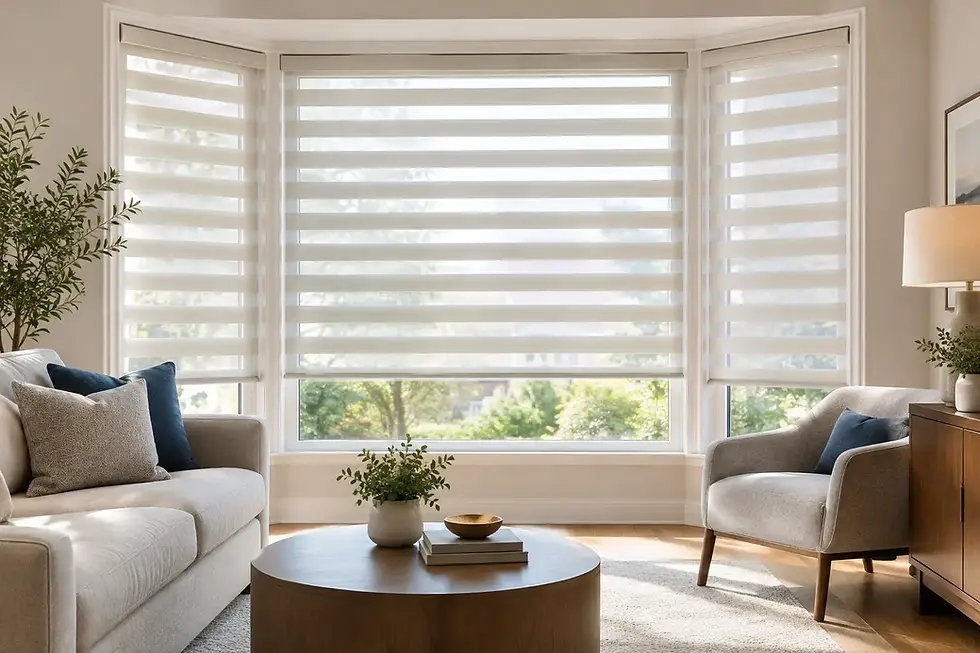
Zebra blinds offer adjustable bands that alternate between sheer and opaque material. They are popular when a room needs more flexibility than a standard roller shade can provide. Roman shades bring a softer, more tailored fabric look, while silhouette-style options diffuse light gracefully through vanes suspended between sheer panels.
The right answer often depends on the room. Using the same treatment throughout a home can create a tidy look, but it is not always the best-performing choice. Coordinating colours and textures across different shade styles can give you consistency without sacrificing function.
Think About Privacy in Daylight and at Night
Many buyers assume any light-filtering fabric provides privacy. It may soften views into the room during the day, especially when daylight outside is stronger than indoor light. At night, that relationship reverses. If privacy is essential after sunset, plan for an opaque material, a blackout option, or a layered treatment.
This is one reason an in-home consultation has real value. Seeing a fabric sample against the window and discussing the room's daily use gives more reliable guidance than selecting from a small online image.
Why Accurate Measurement Is Part of the Product
Custom shades are only as good as the measurement behind them. A few millimetres can influence how neatly an inside-mounted shade sits, whether a roller operates cleanly near trim, and how much light appears at the sides of a blackout treatment.
Professional measuring also identifies details that are easy to miss: shallow window frames, uneven openings, handles that project into the shade path, wide expanses of glass, bulkheads, and ceiling conditions that may affect mounting. In condos, concrete ceilings, sprinkler clearances, and restricted access windows can change the installation plan. In commercial spaces, safety requirements, consistent alignment, and larger quantities demand the same careful review.
A precise consultation should cover more than width and height. It should confirm mounting style, control location, fabric direction, valance options, clearance needs, and how the chosen shade will interact with doors or adjacent windows. This preparation protects both appearance and daily usability.
Compare Quotes on Scope, Not Just the Bottom Line
A lower quote is useful only when you know what it includes. Ask whether the price covers measuring, custom fabrication, mounting hardware, installation, removal of packaging, and any required site coordination. Confirm the fabric collection, opacity level, control type, warranty coverage, and lead time as well.
For motorized shades, clarify whether the quote includes the motor, remote or wall control, charging solution or power planning, programming, and final testing. Motorization can be a worthwhile upgrade for tall windows, hard-to-reach areas, and rooms with several shades operated together. It can also make routines easier for busy households and provide a polished feature in premium rental or development projects. Still, manual controls can be the sensible, cost-conscious choice for straightforward windows used occasionally.
The goal is not to buy the most expensive option. It is to choose a scope that remains clear from consultation to installation. A detailed quote helps avoid surprises and makes it easier to compare like with like.
Material Choices That Support Daily Living
Shades work hard. They face sunlight, dust, cooking vapour, pets, children, and frequent operation. Durable, quality fabrics and components are worth considering because window treatments are a long-term part of the home, not a temporary accessory.
For kitchens, clinics, childcare environments, and multi-unit properties, antibacterial or easy-care materials may be a practical priority. Fire-retardant fabrics can be relevant for commercial settings and projects with specific compliance requirements. In sunny rooms, solar-control fabrics can reduce glare and contribute to better comfort, while blackout materials can support sleep by limiting intrusive exterior light.
Energy efficiency is also part of the equation. A properly selected shade can help manage solar heat gain in summer and add another layer at the window in cooler months. Results vary with glass type, exposure, installation method, and fabric openness, so it is better to treat shades as one useful part of a broader comfort strategy rather than a miracle solution.
The Installation Standard Makes the Difference
Free professional installation has value when it is performed as a defined part of the service, not as a rushed final step. The installer should mount each treatment securely, check operation, align multiple shades where appropriate, and leave the space clean. For motorized products, controls should be demonstrated so the customer understands everyday use.
This is where a direct model becomes especially reassuring. If a question arises about a measurement, fabric selection, or operating detail, there is less distance between the people on site and the people responsible for the order. Millhaüs Blinds combines factory-direct custom window coverings with professional installation so customers can make one informed decision rather than coordinate several suppliers.
For developers and property managers, the same approach can support repeatable results across suites, common areas, offices, and retail spaces. Clear specifications, consistent materials, and organized installation schedules are often as valuable as the product itself.
A Better Way to Plan Your Purchase
Before your consultation, take a quick walk through the space at different times of day. Notice where glare lands, which windows feel exposed, which rooms need darkness, and which ones need easy access to a patio door or balcony. Save a few photos of the room and note any design elements you want to complement, such as flooring, wall colour, cabinetry, or drapery.
Then give your priorities an honest order: privacy, light control, appearance, energy comfort, child-friendly operation, motorization, or budget. Most projects involve trade-offs. A very open sunscreen fabric preserves more view but offers less privacy. A blackout treatment improves darkness but may show a slim perimeter of light depending on the mounting condition. The best recommendation is the one that fits how you actually live and use the room.
A well-planned factory-direct purchase should leave you with shades that look intentional, operate properly, and suit the space long after installation day. Start with the windows that create the biggest daily frustration, ask for a detailed custom quote, and choose a provider that can stand behind both the product and the finished fit.


Comments