
Are Sunscreen Blinds Private Enough for Your Home?
A bright window can make a room feel larger, calmer and more connected to the outdoors. It can also leave you wondering: are sunscreen blinds private enough once the lights come on? The honest answer is that they provide excellent daytime privacy, but their performance at night depends on lighting, fabric openness and the room itself.
For homeowners who want to keep a view while cutting glare and UV exposure, sunscreen blinds are one of the most practical custom window-covering choices available. The key is choosing them for the right windows and pairing them with another layer where complete privacy is non-negotiable.
How Private Are Sunscreen Blinds?
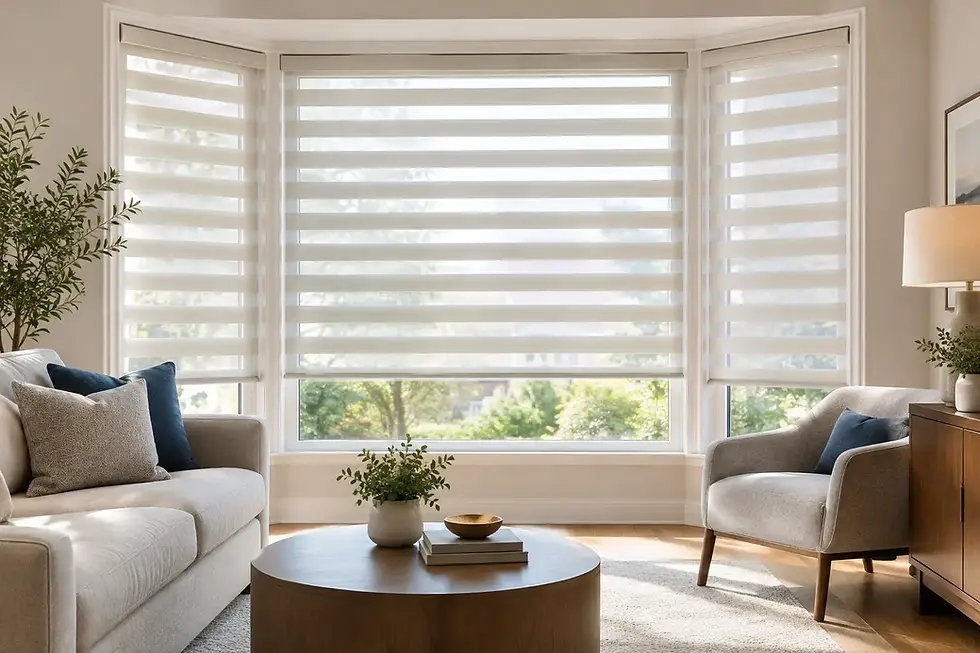
Sunscreen blinds are made from an open-weave technical fabric. Their purpose is to filter sunlight before it enters the room, soften glare on screens, reduce fading on floors and furnishings, and maintain an outward view. During the day, when it is brighter outdoors than indoors, people outside generally cannot see clearly into your home. From inside, you can still see the landscape, backyard or streetscape through the fabric.
That one-way effect is why sunscreen shades work particularly well in living rooms, kitchens, home offices and condo common areas. They give a window a finished appearance without closing off the space or turning every sunny afternoon into a battle with heat and glare.
At night, the lighting relationship reverses. When interior lights are on and it is dark outside, the open weave can allow silhouettes and movement to be visible from outdoors. The lower the openness factor, the better the privacy, but no standard sunscreen fabric should be treated as a complete nighttime privacy solution.
This is not a flaw. It is a design trade-off. A fabric that preserves a broad, clear view must have enough openness to let you see through it. A denser fabric offers more privacy and sun control, while making the view softer and more limited.
Why Fabric Openness Changes Privacy
The most important specification for sunscreen blinds is the openness factor. This percentage describes how much of the fabric is open space. A higher number means a more transparent fabric; a lower number means a tighter weave.
A 1% openness fabric is dense and gives stronger daytime privacy, better glare control and a more muted view outside. It is often a smart option for a street-facing office, a bright media room or a ground-floor window where people pass close by. A 3% to 5% fabric offers a balanced result for many homes: useful daylight control, respectable daytime privacy and a clearer view.
A 10% openness fabric feels airier and gives a more open visual connection to the outdoors. It can be attractive on an upper-level window with a distant view, but it is usually not the right choice where neighbours, pedestrians or nearby buildings have a direct line of sight.
Colour also affects what you see. Darker sunscreen fabrics typically provide a sharper outward view because they reduce reflected light on the room side of the shade. Lighter fabrics can make a space feel brighter and softer, but the view may appear less crisp. Neither choice replaces a dedicated privacy layer after dark.
Daytime Privacy Depends on Your Windows
The same sunscreen shade can perform very differently from one room to another. Before selecting fabric, look at the distance between your window and the nearest home, sidewalk or building. A large family-room window overlooking a private yard has very different needs than a front-facing bedroom near the street.
Window direction matters as well. South- and west-facing rooms often need stronger solar control because afternoon sun brings more glare and heat. East-facing windows may benefit from gentle morning filtering, while north-facing windows may need less sun control but still benefit from a clean, tailored finish.
In Aurora, homes with large rear windows often use sunscreen blinds to protect hardwood, upholstery and artwork without losing the view of the yard. On front-facing or closely overlooked windows, a layered approach is usually the more comfortable choice. The goal is not simply to cover glass. It is to match light control and privacy to how you use the room.
When Sunscreen Blinds Need a Second Layer
Sunscreen blinds work beautifully on their own when daytime glare reduction and daytime privacy are the priority. For bedrooms, bathrooms, nurseries and rooms visible from nearby properties, adding another window covering creates far more dependable privacy.
A blackout blind behind or in front of a sunscreen shade is ideal for bedrooms where darkness and privacy matter. In a living room, drapery can add softness, improve nighttime coverage and create a more layered, finished design. Roman shades can also provide a warmer decorative look while sunscreen blinds handle daytime sunlight.
This combination lets each product do its best job. The sunscreen fabric controls harsh sun without blocking the view during the day. The secondary shade or drapery closes in the evening, when privacy matters most. It is a practical solution for homeowners who do not want to choose between enjoying natural light and feeling protected at night.
Motorization makes the layered approach especially easy to use. Schedule sunscreen blinds to lower when afternoon glare begins, then close privacy shades at dusk. For busy households, condo owners and commercial spaces, this kind of routine adds convenience without asking anyone to manage multiple windows manually every day.
Custom Fitting Makes a Noticeable Difference
Privacy is affected by more than fabric. Gaps at the sides, top or bottom of a window covering can leave sightlines exposed and allow extra sunlight into the room. Made-to-measure blinds are built around your actual window dimensions and mounting conditions, creating a cleaner look and more reliable coverage than an off-the-shelf option.
The mounting style also matters. An inside mount can look streamlined and architectural, but it may leave small light gaps along the sides. An outside mount can provide broader coverage around the window opening, which is useful when privacy or light control is a higher priority. The best option depends on trim depth, window shape, furniture placement and the finish you want.
Professional measuring helps avoid costly guesswork. A consultation should account for handles, mullions, patio-door operation, nearby cabinetry and how far the fabric needs to travel. These details determine whether a shade looks integrated into the room or feels like an afterthought.
Millhaüs Blinds provides factory-direct custom window treatments with professional installation, so homeowners can get accurate recommendations based on real sightlines and room conditions rather than a sample held up at a store display. That approach supports a more controlled result, with premium materials and tailored fitting at a better value.
Where Sunscreen Blinds Work Best
Sunscreen blinds are a strong choice for spaces where sunlight is the problem and a view is worth keeping. Consider them for a kitchen with bright afternoon exposure, a home office with screen glare, a dining room with fading concerns, or a condo living area where you want daylight without feeling fully exposed during the day.
They are also well suited to commercial settings. Offices, clinics, retail spaces and shared work areas often need glare control while maintaining an open, welcoming atmosphere. Selecting an appropriate openness factor can reduce discomfort around monitors and help protect interior finishes without making the space feel closed in.
For a bathroom or street-level bedroom, a standard sunscreen fabric alone is rarely the best answer. Choose a more private blind style, a blackout solution, or a layered treatment instead. Being clear about that from the start leads to a result that performs well beyond the first week after installation.
Choose for the Time of Day You Live In
The best window treatment is not defined by how it looks at noon alone. Think about the room early in the morning, during the brightest part of the afternoon and after sunset with the lights on. If you want filtered daylight, UV protection and a view, sunscreen blinds are an excellent investment. If you need complete nighttime privacy too, build that requirement into the design from the beginning.
A well-measured sunscreen blind can make a bright room more comfortable without taking away what made you love the window in the first place. Book a free consultation to compare fabric openness, colours and privacy options in your own space, then choose a solution that feels right from sunrise through the evening.


Comments