
Voice Control Blinds in Newmarket: Worth It?
- Millhaüs Blinds
- Jul 17
- 5 min read
A sunny Newmarket morning can turn a breakfast nook into the brightest room in the house before the coffee is ready. With voice control blinds Newmarket homeowners can adjust light, privacy, and glare without leaving the table, searching for a remote, or pulling a chain beside a hard-to-reach window. The appeal is simple, but the right result depends on more than choosing a smart motor.
Voice-operated window coverings work best when the blind type, fabric, window dimensions, power source, and installation are planned together. For a custom home, condo, office, or rental property, that planning is what turns a convenient feature into a dependable everyday upgrade.
What voice control blinds actually do
Voice control blinds use a motor to raise, lower, or position the blind through a compatible voice assistant and smart-home setup. Depending on the selected system, you may be able to say, “open the living room shades,” “close the bedroom blinds,” or “set the family room blinds to halfway.” Many systems also allow scheduled operation through an app.
The practical benefit is control by room, time of day, or activity. Lower sunscreen shades during the afternoon to reduce glare on a screen. Close blackout blinds before bedtime. Raise the blinds in the morning without interrupting a routine. In larger homes, this can save a surprising amount of back-and-forth, especially where windows are tall, wide, behind furniture, or grouped together.
Voice control is not only about convenience. It can support better light management, privacy, and energy-conscious habits. Closing shades during periods of intense sun can help reduce heat gain, while using daylight thoughtfully may reduce the need for artificial lighting. Results vary with window direction, glass type, and fabric selection, so a consultation should account for how each room is used.
Where voice-controlled blinds make the most sense
Not every window needs motorization. Manually operated blinds remain an excellent, cost-conscious choice for standard windows that are easy to reach and used infrequently. Voice control earns its place where daily use, accessibility, privacy, or multiple windows make manual operation less practical.
Large, high, and difficult-to-reach windows
Two-storey family rooms, stairwell windows, and windows above a tub or kitchen counter are natural candidates. A motorized roller shade or sunscreen blind gives you usable control without relying on a step stool or leaving the window untreated because it is inconvenient to operate.
For wide patio doors and banks of windows, coordinated control is equally useful. Instead of adjusting several coverings one by one, a single command can set the room for daytime light or evening privacy.
Bedrooms and media spaces
Blackout blinds are a strong fit for bedrooms, nurseries, shift-worker spaces, and media rooms. Voice control lets you close coverings after settling into bed or create a scheduled evening routine. That said, blackout performance is influenced by the product and fit, not just the fabric. A professionally measured and installed system helps limit the light gaps that can occur around the sides of a window covering.
Condos and contemporary living areas
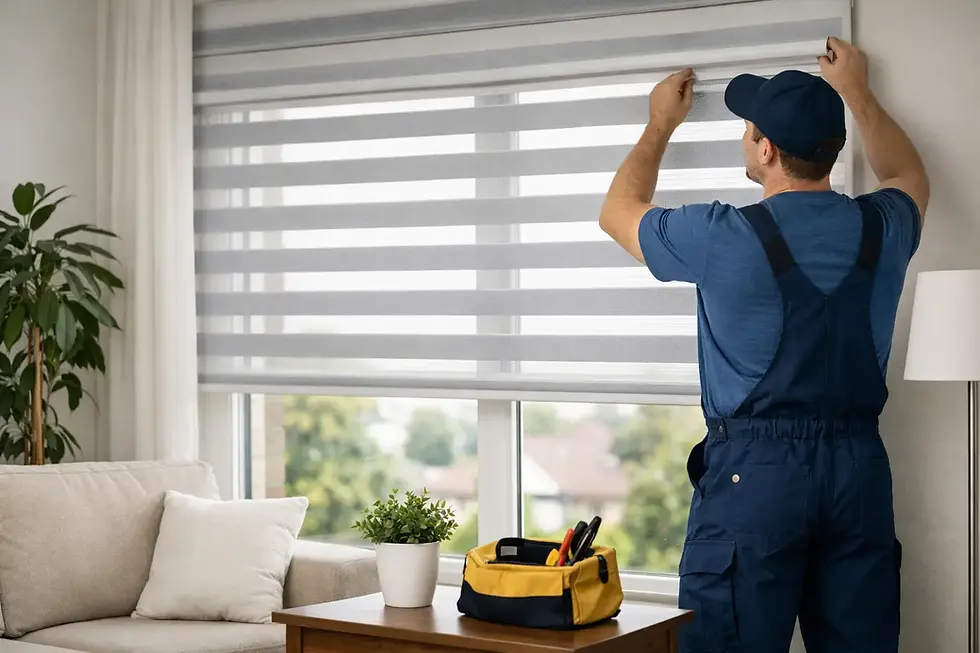
In Newmarket condos and newer homes, clean-lined roller shades and zebra blinds are popular because they suit modern interiors without taking over the room. Motorization keeps the look tidy by removing hanging control chains. Zebra blinds offer adjustable light filtering through alternating sheer and opaque bands, while roller shades provide a clean, versatile option for sunscreen, light-filtering, or blackout fabrics.
Choosing the right blind before choosing the technology
A voice assistant cannot compensate for the wrong window covering. The first decision should be what the room needs from the blind: privacy, darkness, filtered daylight, heat reduction, a view to the outdoors, or a more decorative finish.
Sunscreen blinds are often a practical choice for living rooms and home offices with strong daylight. They soften glare and help preserve an outward view, although they do not provide the same night-time privacy as a blackout product. For bedrooms or spaces where darkness matters, blackout roller shades are usually more appropriate. Some homeowners combine treatments, such as a light-filtering or sunscreen shade for daytime use with drapery for greater coverage and softness.
Zebra blinds offer a flexible middle ground for rooms that need changing levels of light. By aligning the fabric bands, you can move from filtered light to more privacy without fully raising the blind. Silhouette-style options can also create a refined, softly filtered effect, particularly in formal living spaces.
The motor should match the product size and weight. Larger shades and wider openings need suitable motor capacity for smooth, reliable movement. This is one reason made-to-measure products are a better choice than trying to force a standard-size smart blind onto a custom window opening.
Power, connectivity, and daily reliability
The power option affects both appearance and convenience. Battery-powered systems can be a good solution where wiring is not preferred, while hardwired options may suit new construction, major renovations, or large installations where regular use is expected. Rechargeable solutions can also work well, but access for charging should be considered during planning.
Connectivity matters too. Voice control generally relies on a stable home network and compatibility between the motor system, app, and chosen smart-home platform. A good setup should still provide local controls, such as a wall-mounted switch or handheld remote, so the blind remains easy to operate if the internet is temporarily unavailable or a guest is unfamiliar with your voice commands.
There are trade-offs. Voice control adds cost compared with manual blinds, and some owners prefer the certainty and simplicity of a traditional lift system in secondary rooms. Others value scheduled operation more than voice commands. The best design may include a mix: smart shades in primary living spaces, bedrooms, and difficult windows, with manual coverings where automation does not add meaningful value.
Why custom measuring and installation matter
Smart blinds are only as good as their fit. An accurately measured shade sits properly within or above the window opening, moves as intended, and looks proportionate to the room. Details such as trim depth, mounting surface, window handles, door clearance, and the location of nearby furniture should be assessed before a product is ordered.
Professional installation also makes the finished experience easier. The brackets need secure placement, shades must be level, and the controls should be positioned where they are practical to use. For a multi-window project, consistent alignment is especially important. A room can look unfinished quickly when shades sit at noticeably different heights.
Millhaüs Blinds provides factory-direct custom window coverings with professional installation included, helping homeowners avoid the uncertainty of showroom markups, generic sizing, and do-it-yourself mounting. A direct consultation makes it easier to compare fabrics, control options, and operating styles against the actual light conditions in your home.
Questions to ask before ordering voice control blinds in Newmarket
Start with how you want the room to behave throughout the day. Do you need glare reduction for work calls, privacy after dark, a darker bedroom, or a way to manage several windows at once? Then consider the window itself: its size, orientation, accessibility, and whether it is near a door or furniture.
Ask which voice platforms and app features are supported, whether controls can be grouped by room, and what power option is most suitable for the installation. It is also worth discussing fabric openness for sunscreen shades, the expected privacy level at night, and whether one room would benefit from layered window treatments rather than a single product.
For property managers, developers, and commercial buyers, consistency is another priority. Specifying compatible products across units or common areas can simplify daily operation while maintaining a uniform look. In offices, motorized sunscreen blinds can be particularly useful in boardrooms and screen-focused work areas where glare changes through the day.
A well-planned voice-controlled blind system should feel useful rather than showy. Choose the coverage that suits the room, select controls that fit how you live, and have the shades measured and installed for the windows in front of you. That is how a simple spoken command becomes a practical part of a more comfortable Newmarket home.


Comments